TOMO
A home robot for small everyday tasks
We are developing a compact home robot with one arm and a tray: it brings water, carries small items and helps with everyday tasks at home.
Concept renders and animation. Features, specifications, pricing and availability are subject to development and testing.

Everyday help, within reach. A glass of water, the remote, a phone left on the table — small tasks that quietly shape the whole day. TOMO is being built to take a few of them over, at a price a home can justify.
Every day we stop what we are doing to fetch water, pick up a phone or move a small object. For most people that is a short pause. For someone with limited mobility it is a task that needs another person.
A compact wheeled platform, one robotic arm and a tray. The design is focused on everyday usefulness and on keeping the cost under control, instead of on a humanoid that can do everything.
Who it is for
At home
Water and small items carried between accessible areas of the apartment.
Working from home
Simple errands handled during the working day, without breaking focus.
Hard to get up or bend down
Potential help with selected daily tasks. Such scenarios will require additional safety testing.
Pilot participants
Suggest a task, test the prototype and shape the product with your feedback.
TOMO is not positioned as a medical device or as a replacement for a human caregiver.
One helper. Several useful scenarios.
Water delivery
Pour from a compatible cooler into an open bottle and bring it over on the tray. Target — up to 1 litre.
Small items
Take a remote or a phone off a reachable surface and carry it over.
From the floor
We will check whether the arm reaches the floor and holds an object safely.
Several things at once
A remote, keys and a phone travel together in one run.
Navigation
Builds a route and drives around obstacles using its sensors.
Back to the dock
A dock so the robot tops up its charge on its own.
How it will work
You set the task
Control through an app and voice commands is planned.
TOMO reads the situation
Cameras and sensors help locate objects and obstacles.
It performs the action
It drives up, interacts with the object and carries it on the tray.
It reports back
If the task cannot be completed, it stops and asks for help.
The first prototype will work in a prepared area with a limited set of objects and scenarios. Working in an arbitrary apartment will require separate testing.
Concept renders
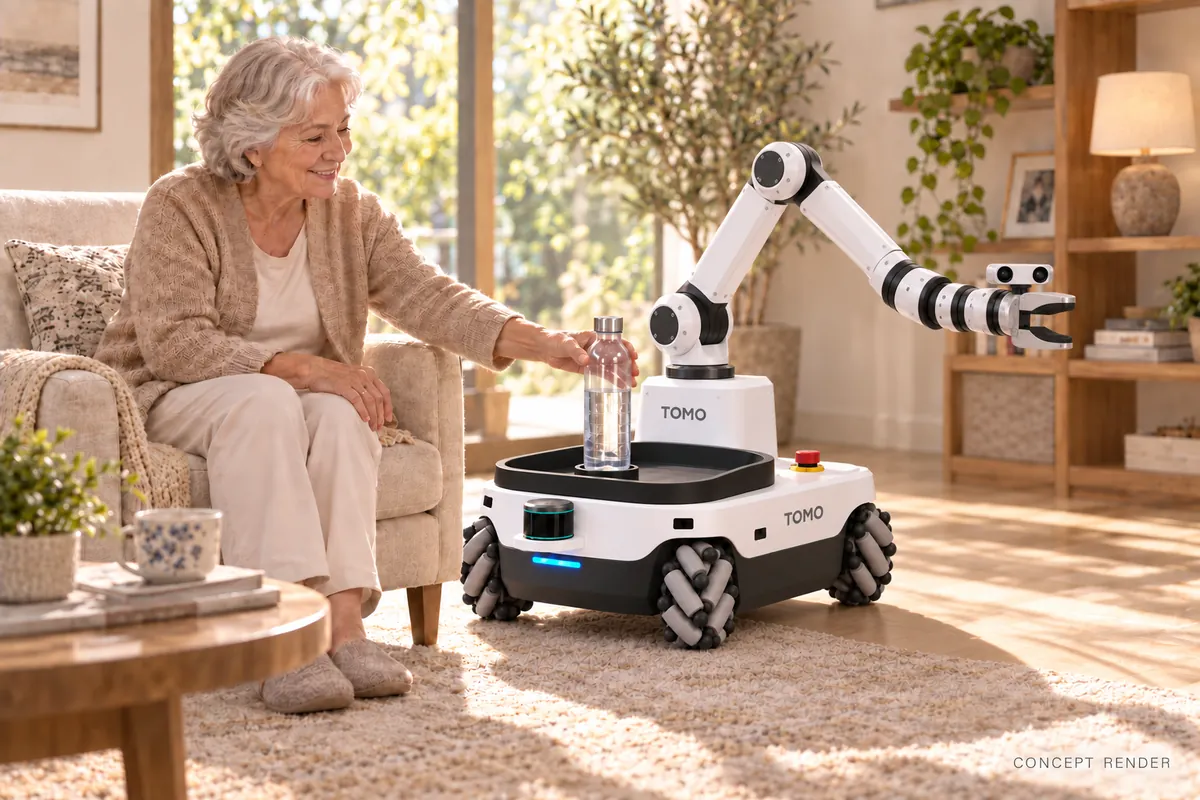
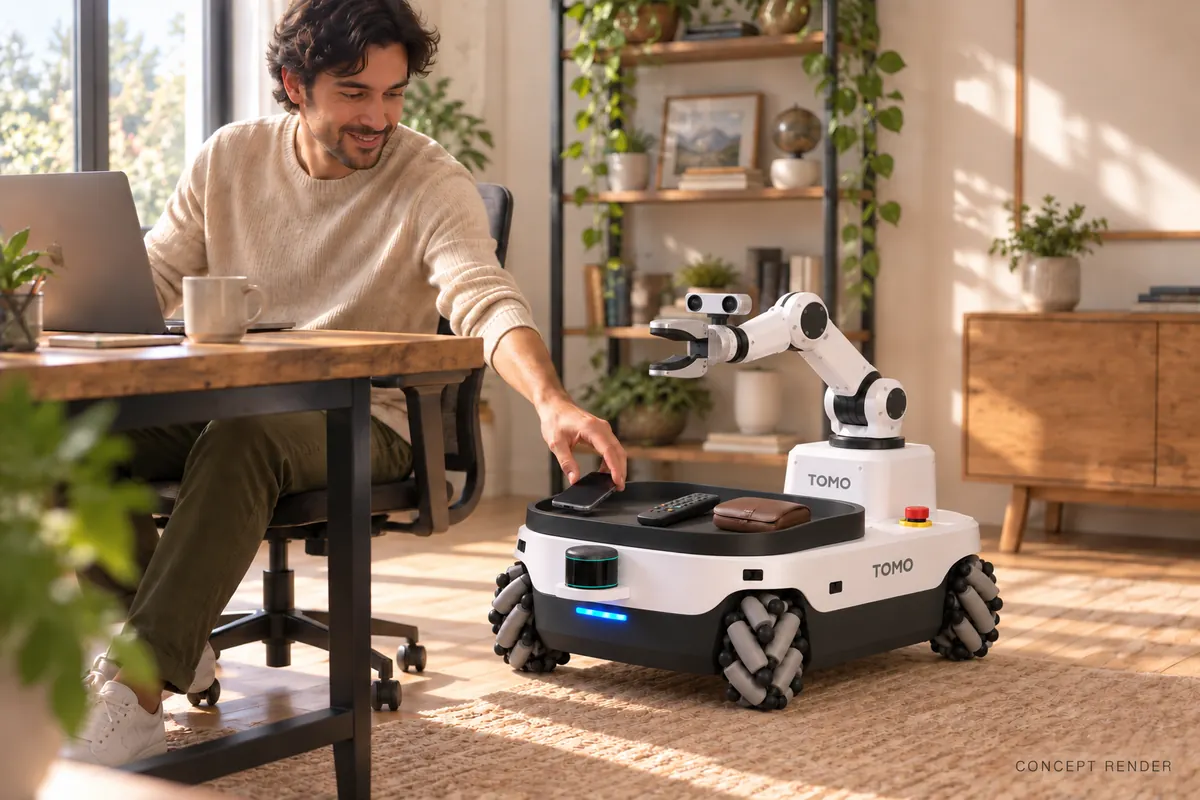
Concept renders and animation. Features, specifications, pricing and availability are subject to development and testing.
Design
The layout in the renders is the current concept. Exact dimensions, the reach of the arm and the payload will be defined on the prototype.
Where it is now
Homes in Kazakhstan and the United States
Roadmap
Validating the design
Choosing components and checking payload, stability and the reach of the arm.
The first working scenario
Pouring water from a compatible cooler and delivering the bottle on the tray in a prepared area.
Pilot testing
Testing in real rooms, measuring reliability and collecting feedback.
Preparing the product
Refining the design, checking target market requirements, organising manufacturing and service.
Pilot dates and the start of sales have not been announced yet.
Availability
Purchase
Your own home robot.
Rental
Using the robot for a regular fee.
Pilot programme
Early access for participants who help test the product.
Price, rental cost, configuration and service terms will be defined after prototype testing and production costing.
FAQ
Can I buy TOMO now?
Not yet. You can join the waitlist or apply to take part in a future pilot.
Is the robot in the photos real?
The site shows concept renders. Photos and video of a working prototype will be published separately.
How much will it cost?
Retail price and rental cost have not been determined yet.
What will the first version do?
The MVP priority is pouring water from a compatible cooler into a prepared bottle and delivering it on the tray in a controlled setting.
Will it carry a litre of water?
That is the target. Calculations and tests have to account for the mass of the water, the bottle and the gripper, and for the position of the arm.
Will it open bottles?
That is not part of the first scenario. Pouring uses a bottle that has been opened in advance.
Will it work in any apartment?
Not right away. For the pilot we will define requirements for passages, flooring, thresholds, furniture and the position of the water cooler.
Can it climb stairs?
Stairs are not part of the current wheeled-platform concept.
Which languages will it understand?
The target interface languages are Russian, Kazakh and English. The set of voice features will be defined during development.
Will it stream video to the cloud?
The data processing and storage architecture has not been approved yet. Camera access and data handling terms will be disclosed before the pilot starts.
The team

Maxim Marchenko
Founder of the projectIT entrepreneur, developer and director of MAXICO. Co-founder of CyberPol Kazakhstan, EBRD consultant, BlockchainKZ expert and member of the IT council at the Atameken chamber. TOMO combines his experience in digital products with the task of building a physical helper for the home.
TOMO Robotics
Mechanics · electronics · computer visionWe are looking for partners in mechanics and electronics, robotics and navigation, prototyping and manufacturing, and for investors for the development stage.
What would you ask TOMO to do?
Write to us to follow the development, suggest your own scenario or discuss taking part in the pilot.